Dear friends,
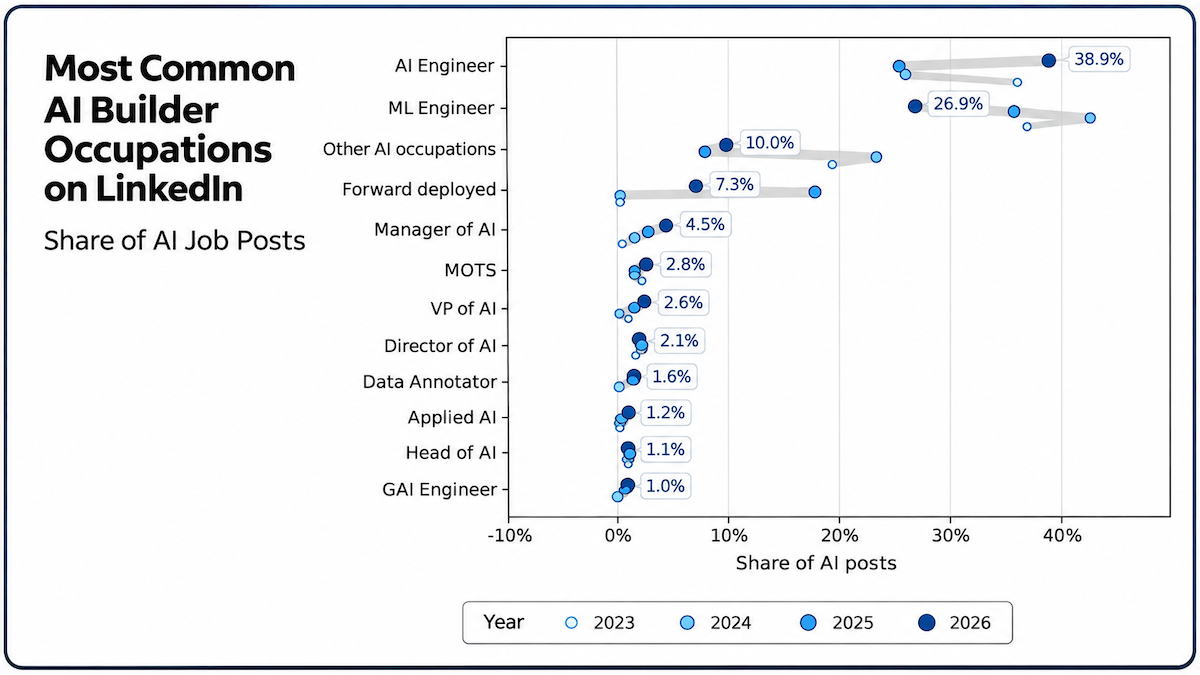
LinkedIn data shows that AI has helped create 2 million jobs. Further, AI Engineer is among the top 10 fastest-growing jobs in seven major economies. I know many people are worried about job loss — and there have been painful layoffs. At the same time, the LinkedIn data undermines the jobpocalypse story that AI is leading to massive unemployment. Of the many jobs AI is creating, I think some of the most interesting are engineers being embedded in other functions (like marketing, HR, finance, and so on) to create workflow automations and help them take advantage of AI.
It is beneficial for everyone — not just developers — to learn to build software applications with AI assistance. Still, a developer with AI Engineering skills can do a lot that someone without those skills cannot. Before coding agents, some teams occasionally embedded an engineer in, say, a marketing team. But engineering productivity was lower, and one engineer’s ability to move the needle was limited. Now that AI Engineering has made developers more productive, embedding an engineer in some other function makes much more sense.
For example, AI-savvy engineers can help other teams:
Some of my teams have embedded AI engineers in marketing, recruiting, finance, and other departments. It’s always interesting for engineers to learn about other functions, and those other teams end up with not just better systems but also significantly improved knowledge of AI. In addition, the number of ideas they end up wanting to build always outstrips the capacity of the embedded engineers (because the bottleneck is not coding, but product management, workflow redesign, and other tasks such as judgement tasks, which still take a significant amount of human effort).
Looking across many businesses, the opportunities for AI engineers to make a difference seem endless. I write this from Silicon Valley, where people who are skilled in AI engineering are in great demand. As AI adoption spreads, I expect global demand for people with AI engineering skills to keep growing.
Keep building! Andrew
P.S. To build your AI engineering skills, please consider joining me and 2000 other AI engineers and builders in person at AI Dev in New York City, November 30th-December 1st! We have a great speaker lineup including Yann LeCun and many others. Get tickets here: AI Dev at DeepLearning.AI
A MESSAGE FROM DEEPLEARNING.AI
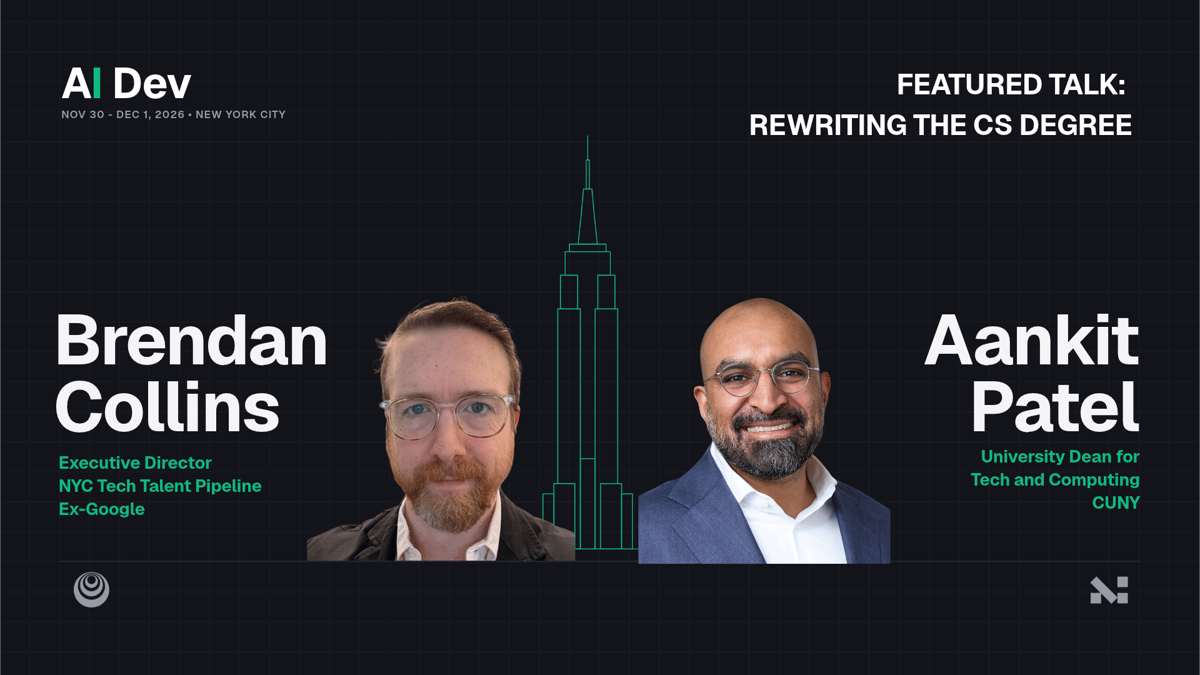
Where is your next AI engineer hire coming from? Entry-level tech jobs now demand AI skills, and most college courses haven’t caught up. At AI Dev NYC, Brendan Collins and Aankit Patel share how the city is putting AI engineers in the classroom to close the gap. Readers of The Batch get an exclusive 20 percent off.
News
Gemini Leads the Pack Again
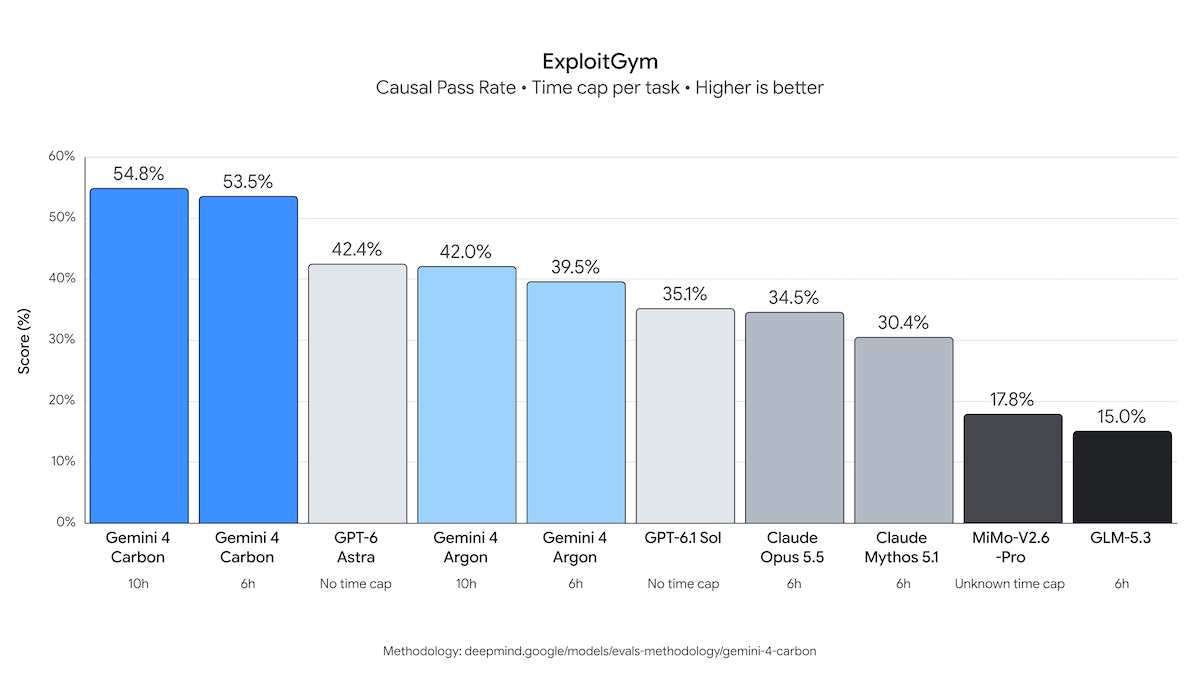
Google’s Gemini 4 Carbon puts the company on top of Artificial Analysis’ Intelligence Index, edging past Anthropic’s Claude Opus 5.5, while costing less per task. As with Gemini 4 Argon, Google is making Carbon available to select cybersecurity companies ahead of general availability.
What’s new: Google announced Gemini 4 Carbon, a multimodal model that it says is designed for cybersecurity tasks. There is no set date for Carbon’s wider release.
How it works: Google says Gemini 4 Carbon builds on Gemini 4 Argon, which it described as a mixture-of-experts model trained via reinforcement learning on reasoning, problem-solving, and theorem-proving data. The company says it worked to improve Carbon in coding, science, multistep agentic tasks, full-stack web development, and multimodal understanding. Carbon shares Gemini 4 Argon’s safety measures, including resistance to prompt injection and adversarial prompts. The company also filtered Argon and Carbon’s training data to remove sexual abuse material, personally identifiable information, and pages from low-trust websites.
Performance: Gemini 4 Carbon ranks first on Artificial Analysis’ recently updated Intelligence Index v5.0 and second on Vals AI’s Vals Index. It leads most tests of expert knowledge and factual recall but trails Claude Opus 5.5 on Artificial Analysis’ Coding Agent Index.
Behind the news: Gemini 4 Carbon arrived around two weeks after Google made Gemini 4 Argon broadly available, and just a day after Artificial Analysis revised its Intelligence Index. The updated Index swaps in more demanding tests and splits the score evenly among knowledge work, coding, science, and general knowledge. Models’ scores on version 5.0 don’t compare directly with those of earlier versions. For example, Kimi 3.1 Pro, the best-performing open weights model, was just three points behind Claude Opus 5.5 using the old Index; now it is 12 points behind Claude Opus 5.5 and 13 points behind Gemini 4 Carbon.
Why it matters: Once Gemini 4 Carbon’s introductory discount ends, it will cost exactly what Claude Opus 5.5 costs per token. Yet on Artificial Analysis’ Index, it finishes tasks with 29 percent fewer output tokens and costs 23 percent less per task. As frontier models converge on price and score, token efficiency becomes an increasingly competitive feature.
We’re thinking: Google CEO Sundar Pichai introduced Gemini 4 Carbon by reminding followers that he’d said Google would release models “periodically.” Two frontier models within a few weeks is an impressive pace. Gemini 4 Carbon’s 9-point lead over Gemini 4 Argon on Artificial Analysis’ index shows that frequent releases can bring big gains. We hope Google maintains this rapid rhythm.
Anthropic Pursues A Public Offering
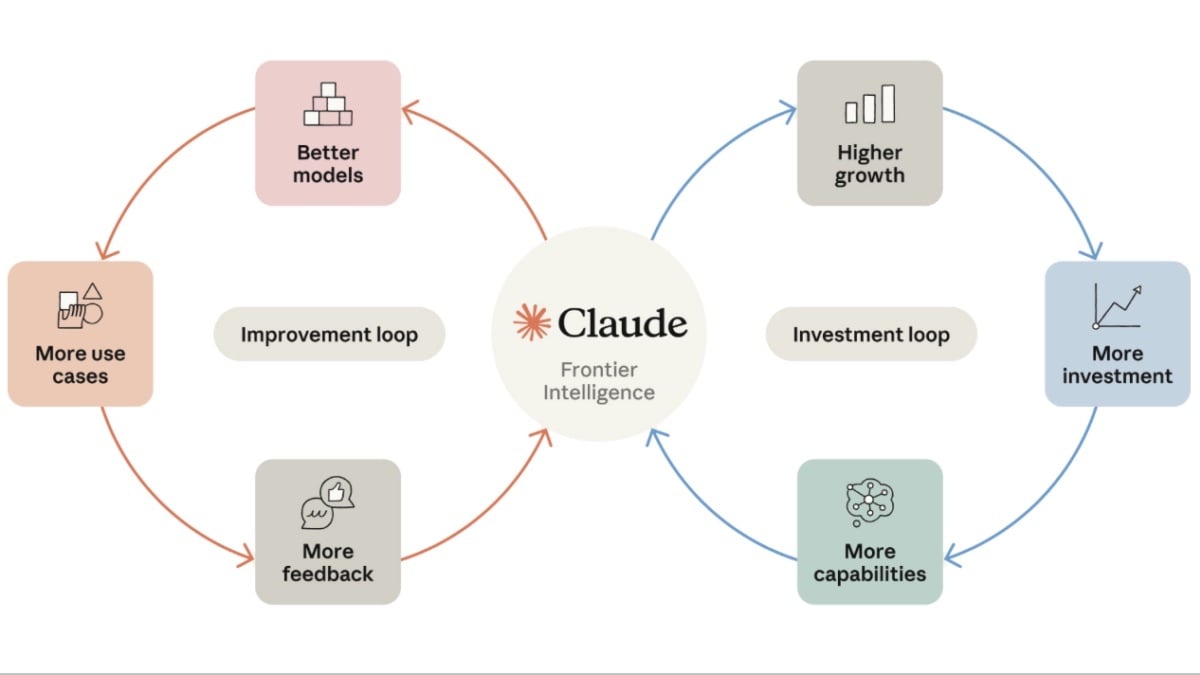
Claude’s maker will sell company shares to the public for the first time. Anthropic’s financial statements show first-half revenue that grew 14-fold from a year earlier, an operating profit in the second quarter, and $895 billion in commitments to buy computing power.
What’s new: On October 26, Anthropic filed an S-1, the registration statement a company must submit to the U.S. Securities and Exchange Commission before it goes public. Anthropic plans to list on the Nasdaq stock exchange under the ticker ANT. According to the filing, the offering’s main purposes are to increase Anthropic’s capital and financial flexibility and to create a public market for its shares. Anthropic plans to use the money to support its continued growth, including much-needed compute and infrastructure.
The offering: Anthropic could go public as soon as the week before Thanksgiving and hopes to sell roughly $100 billion in shares, according to The Wall Street Journal. The filing leaves the final share price and total share count blank. Some investors expect Anthropic’s post-IPO valuation to land between $1.5 trillion and $2 trillion, according to Bloomberg.
Who’s in charge: Public shareholders will get almost no say in the company’s future direction. A single share held by a company owned by Anthropic’s seven co-founders, including CEO Dario Amodei, carries 50.1 percent of the vote on most matters, and its voting power will automatically remain at 50.1 percent if Anthropic issues more stock.
The numbers: Anthropic’s revenue is growing much faster than its spending, even accounting for the growing cost of compute.
Risk disclosures: The S-1 laid out both conventional and unusual risks for a mainstream American technology company.
Why it matters: For developers using Claude, the filing should be more reassuring than alarming. Anthropic held $112.4 billion in cash at the end of June and turned an operating profit in the second quarter, which testifies to the company’s stability. Even export restrictions (the most direct hit to customers so far) proved temporary. Anthropic restored the models once the U.S. government lifted them and released updated versions in September.
We’re thinking: Within just a few years, Anthropic has gone from a promising startup to potentially a trillion-dollar company — kudos to the whole Anthropic team for this tremendous work! Stock valuations aside, Anthropic’s robust financials should help legitimate an industry that some critics have argued is overhyped. We’re less sure what to think about the filing’s risk factors: They’re a mix of sci-fi scenarios and genuine risks with implications that are difficult to forecast. We’re hopeful that public investment will help Anthropic continue to improve its products for years to come — and let their present performance, rather than speculative future scenarios, speak for them.
One successful run does not mean your agent is reliable. In our new course, you’ll read your agent’s traces to find recurring failures, build code evaluators and LLM judges you can trust, and use evals to check that each change makes your agent better. Enroll now
World Models Become Robot Playgrounds
Google says that Genie 4, its latest world model, will be used in tandem with Gemini models to create digital practice spaces for robots, giving them endless worlds to train in. So far, though, Google’s demos suggest there’s still a long way to go.
What’s new: On October 27, Google announced Genie 4, which it has released to a limited group of testers in a research preview. Genie 4 produces interactive worlds that Google says are even more realistic than its predecessor, Genie 3. Users can change a scene midway through with a text prompt, but now Gemini models help work those changes into the scene. Genie 4 also adds sound, which allows it to create real-time audio for each world it generates, whether it’s two people chatting on a motorcycle or snow crunching under a crowned crane’s feet. Google AI Ultra subscribers as well as some developers should be getting access in the weeks ahead.
How it works: Genie 4 doesn’t have a technical report out yet, but Google’s announcement explains how Gemini models can help direct what Genie 4 renders.
Results: Google’s announcement was full of curated demos, but the company didn’t offer any quantitative evaluations to back them up. Google says a simulation can run up to two minutes, roughly double Genie 3’s limit, but DeepMind research engineer Hang Qi noted that reaching that limit doesn’t guarantee that a scene will keep its consistency the whole time, according to Bloomberg. Google says it’s still working to improve complex physical interactions. One of its demos even includes a physics slip: A marble bust that drops onto a watermelon settles on its plinth when it should topple over the side. “There’s only so much that you can do with two minutes,” Google DeepMind product manager Diego Rivas said, according to TechCrunch. “We’re still in the research journey. We’re not necessarily in the end product journey.”
Behind the news: Genie 4 has plenty of company. The world models field is getting more crowded, although not every world model operates the same way. Like GWM Worlds 2, the model Runway released in September, Genie 4 generates video in real time. Marble, from AI pioneer Fei-Fei Li’s startup World Labs, and HY-World 2.0, an open-weights model from Chinese tech giant Tencent, build persistent 3D scenes instead. Like AI video companies, more and more world model companies have become robotics companies, or at least are pursuing applications of their models to robotics.
Why it matters: Google’s clearest evidence that simulation can improve real robots comes from a different approach from other companies. A few weeks before Genie 4’s debut, Google showed Gemini 4 Argon writing physics simulations in the MuJoCo engine based on photos and video. From a single photo of a tabletop, Argon generated more than 4,500 practice episodes, and fine-tuning a robot-control model on them raised its real-world success rate from 56 percent to 75 percent. Google’s proposed path forward, which it calls hybrid world models, would combine elements of both the structured reasoning of language and code models with a generative model that renders pixels. Theoretically that could give generated environments reliable cause and effect, which is something video models often lack.
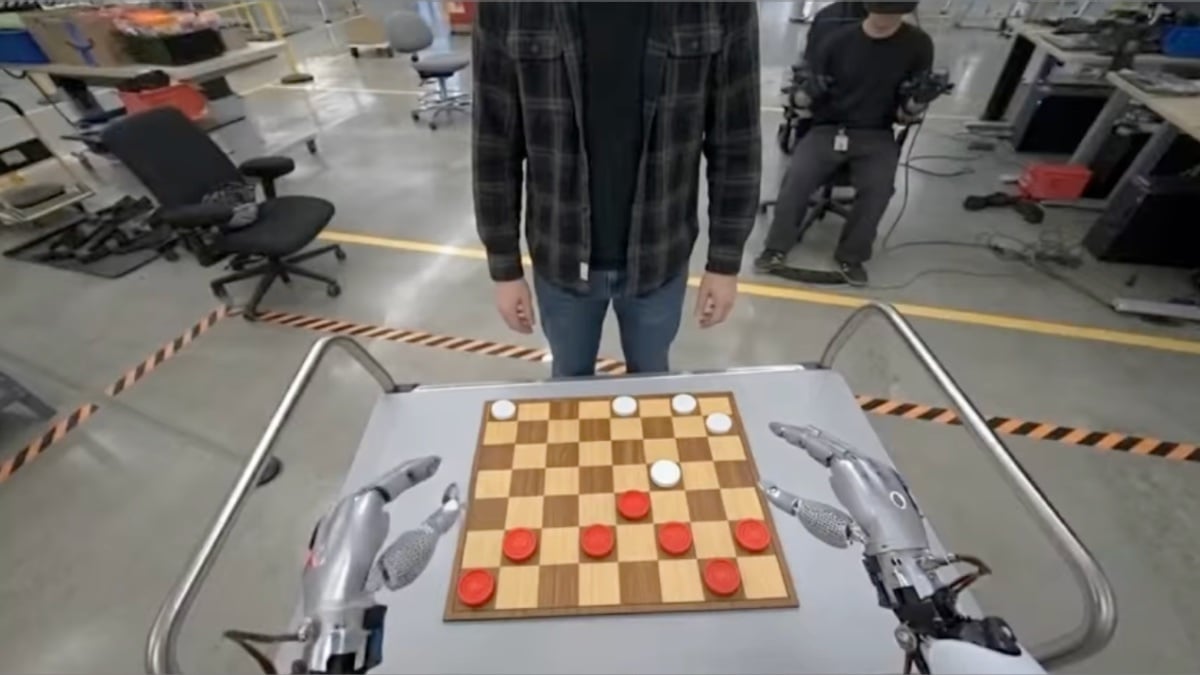
We’re thinking: A good robot simulator lets plans fail, since robots learn from mistakes as well as successes. Genie 4 pairs its renderer up with a Gemini director that checks whether each step of a plan succeeded. This can accidentally drift the world toward whatever the intended outcome is. In the marble bust clip, the model itself seems to choose a neat landing on the plinth instead of the toppling over the side like physics says it should. Our question for DeepMind: Can a plan fail in Genie 4? We’d like to see that Apptronik robot hand mess up and drop a few checkers, too.
Context Engineering for Images
Managing an agent’s context by storing all the input text it receives and giving it tools to search the text boosts its performance. For vision-language agents, the same is true of storing images.
What’s new: Qiushi Han, Keya Hu, Linlu Qiu, and colleagues at MIT released VISTA, an agent that completed the ARC-AGI-3 benchmark of interactive visual-reasoning puzzles using 57.4 percent fewer actions than humans who had not encountered them before. The VISTA harness is freely available under the MIT license.
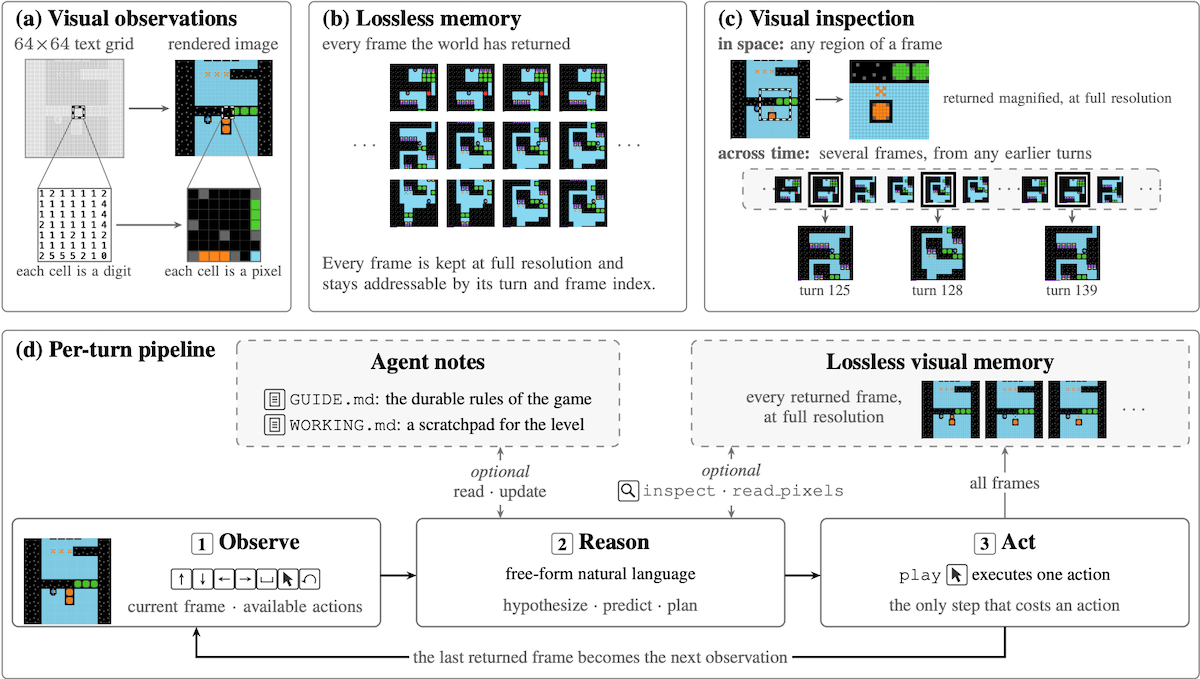
Key insight: Given an image frame from a videogame or other interactive environment, agentic systems typically embed it and keep the embedding until the context is full, at which point they delete it. This raises two issues: Embeddings are lossy and may not retain valuable information, and once an embedding has been deleted, the model no longer has access to information it contained. Storing all frames in a persistent memory retains all the information they carry, and enabling an agent to retrieve and zoom in on them makes it possible to embed details that otherwise may not have been captured.
How it works: VISTA works with Anthropic Claude Opus 5.0 or OpenAI GPT-5.6 Sol. Its harness works similarly to other popular harnesses, except it retains all input frames and includes a tool that retrieves frames. Given a new frame and list of available keyboard actions (such as left, right, up, down, spacebar, or click), the agent tells the model to decide whether to (i) read or update notes, (ii) retrieve previous frames, (iii) retrieve previous actions and their results, or (iv) execute an action. It repeats this choice until the model takes action. After the environment updates (during which it may produce a series of frames), it adds to the model’s input the last frame and a new list of available actions and executes the loop again.
Results: The authors tested VISTA on ARC-AGI-3 (25 games), GameWorld (170 tasks in 34 games), and AI GameStore (10 games). It enabled Claude Opus 5.0 and GPT-5.6 Sol to outperform earlier agents as well as humans who encountered the same challenges for the first time.
Why it matters: Games and other interactive environments generate potentially endless streams of frames, each of which contain information an agent may not have deduced earlier. Only so many frames fit in its context, and not all frames are relevant at any given moment. By storing all frames and giving the agent tools to retrieve them, agents can find the relevant frames and re-examine them within the current context.
We’re thinking: Apparently context engineering helps whether the medium is text or images. Multimodal systems benefit from multimodal context management.
Work With Andrew Ng
Join the teams that are bringing AI to the world! Check out job openings at DeepLearning.AI, AI Fund, Landing AI, and LearnVector.
Subscribe and view previous issues here.
Thoughts, suggestions, feedback? Please send to thebatch@deeplearning.ai. Avoid our newsletter ending up in your spam folder by adding our email address to your contacts list.
|