Welcome back! In today’s edition of Data Points, you’ll learn about our top headlines, and more:
Model Hardware Standard move towards open source release
Gemini 3.5 Transcribe impresses on accuracy tests
Speech-to-text leaderboard expands beyond European languages
U.S. gov’t discriminated against Anthropic, court finds
But first:
OpenAI moves to shut down model access for Cursor’s IDE
OpenAI notified SpaceXAI that it will end its contract supplying OpenAI models to Cursor, the AI coding tool SpaceXAI recently acquired. OpenAI says it is giving the maximum notice allowed under its agreement, which includes a limited window to cancel after a change of control. The company cites past contract violations by Elon Musk’s companies as its reason, pointing to Twitter/X breaking OpenAI’s terms after Musk’s acquisition and Musk’s admission under oath that xAI had violated OpenAI’s terms of service. OpenAI also cites new accountability requirements tied to its upcoming model, Astra, as a factor in ensuring compliance. Developers using Cursor with OpenAI models will keep access until November 12, 2026, but Cursor will not receive OpenAI’s models beyond that point. (OpenAI)
OpenClaw’s popular open source agent, now rebuilt
OpenClaw released version 2.0, built by nearly 1000 contributors (over 500 first-time) following a nearly seven-week gap in releases. The update reworks installation, messaging, memory, skills, models, automations, the browser and native apps, plugins, and security, which accounts for roughly half of all pull requests ever merged into the project. First-time setup now detects existing ChatGPT or Claude subscriptions, API keys, and local models already on a user’s machine, letting people reach a first conversation before finishing configuration through chat. A new feature called shared cloud sessions lets multiple people join or hand off an ongoing session without losing its context, which OpenClaw’s team used internally while building this release. OpenClaw is open source, and the update gives developers a lower-friction path to self-host an AI assistant that can be extended into multi-user workflows. (OpenClaw)
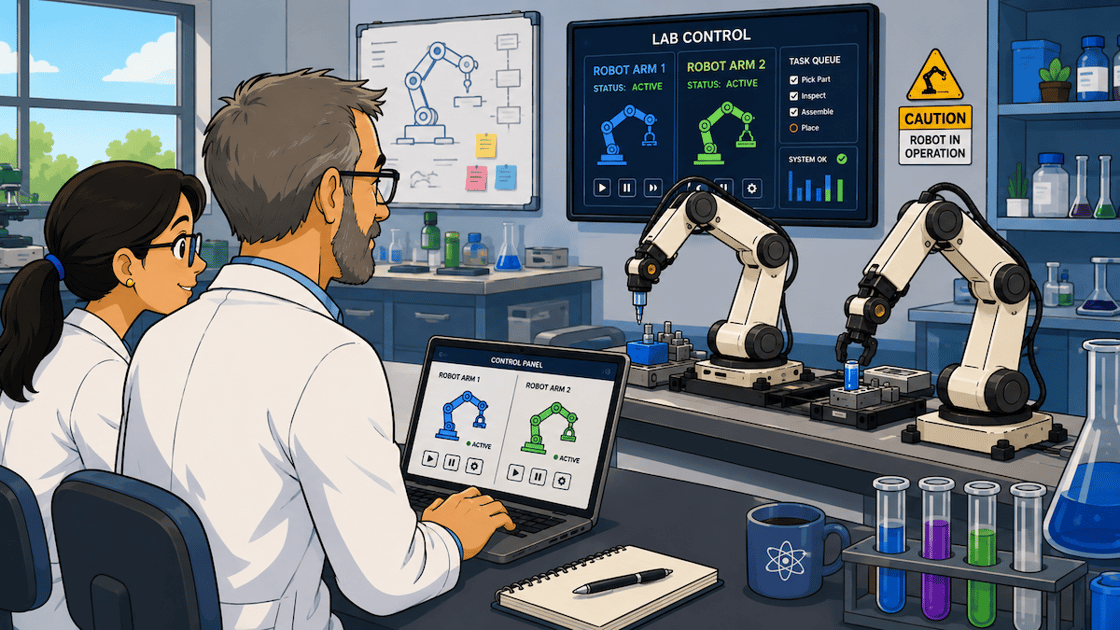
Anthropic builds an MCP equivalent for agentic lab work
Anthropic opened a research preview of the Model Hardware Standard (MHS), which lets AI agents operate lab and manufacturing hardware such as microscopes, liquid handlers, and robotic arms. MHS uses a standardized driver with simple “read” and “write” commands so any device with a programmable interface can be discovered and controlled without custom integration code, cutting setup time from weeks to hours. It works with agent protocols such as Model Context Protocol and is not tied to Claude specifically. The standard was built with HHMI Janelia Research Campus, and early partners including Genentech, Carnegie Mellon, University of Washington labs, and QuEra Computing report faster experiment cycles. AWS, Tecan, Automata, and Universal Robots are building in support. Anthropic says Claude’s spatial reasoning still has limits requiring expert oversight; the company plans to publish safety findings before open-sourcing the standard. (Anthropic)
Google competes with Scribe, Whisper, others on transcription
Google released Gemini 3.5 Transcribe, a speech-to-text model available via two APIs: a real-time streaming version (gemini-3.5-transcribe-live) for voice apps and a pre-recorded version (gemini-3.5-transcribe) with speaker attribution and word-level timestamps for up to three speakers. According to benchmarks from Artificial Analysis, it achieves a word error rate of 4.0 percent for streaming and 2.6 percent for non-streaming transcription, and Google says transcription time improves 70 percent over its previous model, Chirp 3. The model supports over 85 languages, cleans up filler words and self-corrections automatically, accepts custom vocabulary, and can trigger function calls to other Gemini models for tasks like image generation or file analysis. It’s in public preview now in Google AI Studio and the Gemini Enterprise Agent Platform, and third-party platforms including LangChain, LiveKit, Pipecat, and Vercel already support it through the Live API. Developers building voice agents or call-transcription pipelines get a model with lower error rates and sub-second latency without needing to build separate noise-handling or formatting logic themselves. (Google)
Hugging Face tracks speech-to-text in Hindi, its first Asian language
Hugging Face’s Open ASR Leaderboard (which ranks automatic speech recognition, or ASR, models by accuracy) added its first Indic language sets: Monsoon en-IN and Monsoon hi-IN. The leaderboard previously covered only European languages. The data comes from unscripted, dual-channel phone conversations recorded by 4,888 speakers across hundreds of Indian districts, each tagged with 12 attributes including age, occupation, device model, and native district. Each language has a public split for self-scoring and a private, held-out split so models can’t be tuned to the test data; Hindi references use a lattice of accepted spelling variants rather than one fixed transcript, since no normalizer can resolve Hindi’s spelling variations. Prior research cited here found ASR error rates ranging from about 4% to 44% across different districts, a gap that standard aggregate word-error-rate scores don’t show. The results show that South Asian languages require different assessment tools, but show promise as ASR extends to billions of speakers on the subcontinent. (Hugging Face)
Anthropic wins a key case against the U.S. government
A federal judge ruled that the Pentagon acted illegally when it labeled Anthropic a supply chain risk earlier this year. U.S. District Judge Rita Lin found the designation was retaliation for Anthropic CEO Dario Amodei’s public criticism of the Defense Department’s AI policies, not based on any real security concern, writing that the government wanted to “make a public example out of Anthropic for its ‘arrogance.’” The dispute began in February after President Trump and Defense Secretary Pete Hegseth accused Anthropic of endangering national security, following Amodei’s refusal to let the company’s models be used for mass surveillance or autonomous weapons without restriction. Anthropic sued the Pentagon in March, and Lin’s 59-page ruling found neither the Constitution nor the federal statute the government cited allows penalties based on criticism of administration policy. The government is expected to appeal, and a separate, narrower case remains pending in the D.C. appeals court. (AP News)
Quote of the week
Want to know more about what matters in AI right now?
Read the latest issue of The Batch for in-depth analysis of news and research.
Last week, Andrew Ng talked about the continued importance of understanding software engineering fundamentals in the context of agentic coding, emphasizing the ability to build full-stack applications, manage data, and design system architectures to make informed tradeoffs and ensure secure, reliable, and scalable systems.
“Even when you use a coding agent to write all your code, understanding software fundamentals is important for steering your agent to make the tradeoffs you want — or to even know what tradeoffs exist to be made. Additionally, when you’re building an AI application, the AI core is often expressed through a broader software application, which a skilled engineer will shape.”
Z.ai delayed its open weights release for GLM-5.3 due to cybersecurity risks, marking a new approach to AI safety protocols.
DeepSeek’s flagship model, DeepSeek-V4-Pro, only slightly outperforms its Flash sibling, but its open source agent harness is drawing significant interest from the AI community.
OpenAI partners with Cerebras, Google releases Gemini 3.7 Flash, and Nvidia debuts Nemotron 3.5 Lightning, highlighting the AI industry's ongoing race for speed.
DeepLearning.AI’s first-ever subscription plan for our entire course catalog includes foundational classics like the Machine Learning and Deep Learning specializations plus seminars on the latest tools and frameworks you need.
As a Pro Member, you’ll immediately enjoy access to:
Nearly 200 short and long AI courses from Andrew Ng and industry experts
Labs and quizzes to test your knowledge
Projects to share with employers
Certificates to testify to your new skills
A community to help you advance at the speed of AI
Enroll now to lock in a year of full access for $25 per month paid upfront, or opt for month-to-month payments at just $30 per month. Both payment options begin with a one-week free trial.