Dear friends,
Before modern AI tools accelerated and expanded what a single developer could do, tech companies established the practice of having product managers (PMs) and designers specify what should be built and then developers build it. Perhaps a project manager additionally drives the timeline. However, these roles are blurring. A developer who is skilled at AI engineering not only builds software but participates in these other roles. (Similarly, product managers and designers are gaining AI Engineering skills and participating in building software.)
This change is vastly accelerating software development. When you know how to shape the build, you can move faster without waiting for a PM to figure out what to do.
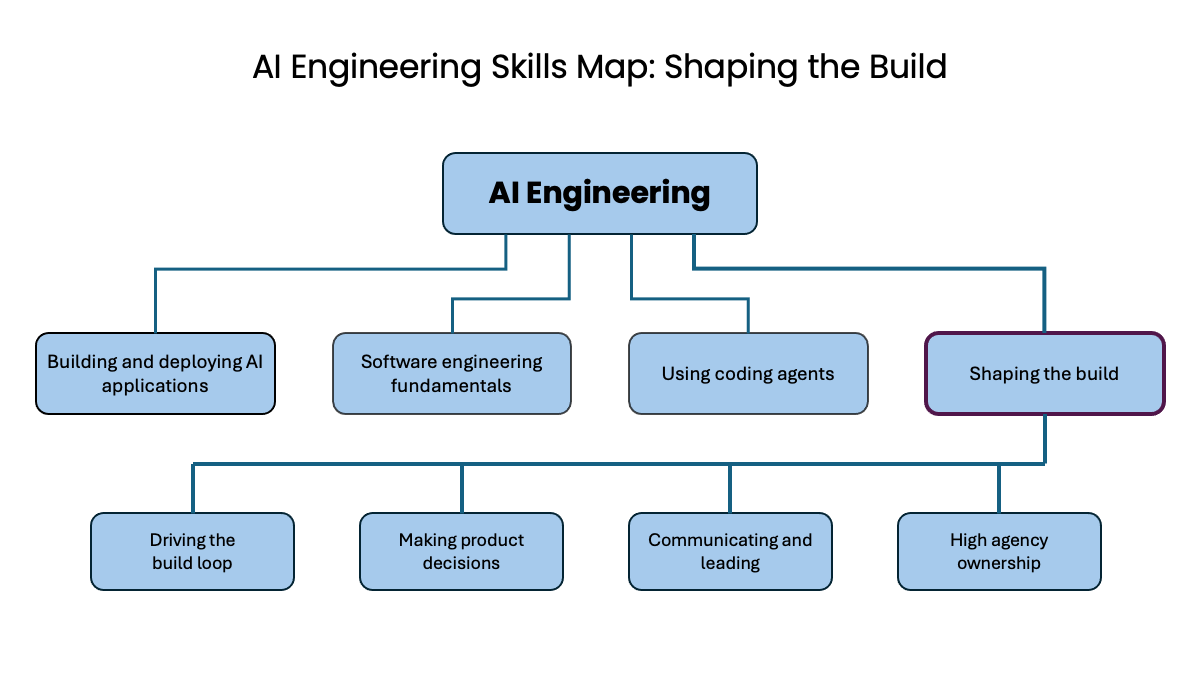
The key skills for shaping the build are:
Driving the build loop. Most software is built via a loop in which you write some code, then get some feedback, and decide what to do next. As a skilled AI engineer, you play a key role in driving this loop, repeatedly deciding on the next step to move your project forward. You have a bias for action, and drive this loop at the high velocity that AI has made possible.
For example, you might decide to build a quick prototype to test a technical concept or user feature, build an MVP (minimum viable product) to take to users to demonstrate value, add features, or invest in an enterprise-grade system. You frequently ship in small batches to keep up velocity. You know when to get feedback from users or other stakeholders, or when to run a technical experiment (such as train a model) to gather information to decide the next step. You make these decisions taking into account the product vision, stage of the project, technical feasibility, key risks, effort, and budget. For more mature projects, you know how to define key metrics and project-manage to drive improvements to those metrics.
Making product decisions. Developers don’t have to become PMs, but you will make decisions the product spec doesn’t cover. If you are asked to build without a spec, you know how to develop one.
You have product sense that enables you to pick a product direction that meets real user needs, without having to wait for a PM to make every decision. You also have at least a basic design sense, and can build things that aren’t just functional but pleasing to use. You also have some basic business sense, so you can think through issues like go-to-market, market size, unit economics, and profit and loss (P&L) and make tradeoffs that are economically sensible. Your ability to make product decisions is rooted in your user empathy. Further, you continually hone this empathy using a wide range of methods, such as quick informal interviews with 2-3 users, surveys of hundreds of users, large-scale A/B tests, or analyzing the behaviors of thousands or millions of users. You use the resulting input to improve your understanding of users.
Communicating and leading. Your skills in AI Engineering enable you to participate in a broader scope of work than traditional software development allowed. I’ve written previously about how specialized developers (like frontend developers) are now likely to play a broader full-stack role. AI Engineering skills open the door to expanding your scope even beyond this: You might participate in other functions that affect your project like marketing, finance, legal, and so on. This makes your ability to communicate with these other functions more important than before — you can play a key role moving your project forward by aligning and coordinating among stakeholders. (Communication skills also form an important foundation for speaking with users to hone user empathy.)
Additionally, because AI technology is rapidly evolving, many people outside of engineering are trying to understand the technology, its impact on their jobs, and the new practices and products it makes possible. Your technical skill in AI Engineering puts you ahead of the game and allows you to play a unique role in shaping these perspectives. For example, you can explain why certain initiatives may be technically feasible or not. This allows you to help lead your broader organization forward.
High-agency ownership. AI engineering skills give you vast opportunities to make a difference. However, many people — including some executives — do not yet understand what AI can do and therefore do not know what are good project directions. This creates an opening for someone with technical skill to bridge this gap: You can spot problems, propose solutions, and execute on them — being respectful of the organization’s priorities and constraints, but without waiting for precise top-down direction. This skill requires a high degree of agency, in which you identify opportunities, prioritize what matters, and act on them. Additionally, you know how to own an initiative end-to-end, take accountability for issues that arise, act in the face of ambiguity, persist through setbacks, and measure your work not just by task completion, but according to the value you create.
Finally, you invest in improving your skills. You track the technology frontier, pick up new tools, tune your workflows, and keep on learning — so you become better over time.
The opportunity to not just build but to shape the build makes AI Engineering more exciting than traditional software development. You are more empowered, have broader scope, and make more decisions. But doing all this well requires a larger set of skills. DeepLearning.AI’s focus is to help you, if you wish, become skilled at AI Engineering.
I look forward to the road ahead! Andrew
A MESSAGE FROM DEEPLEARNING.AI
AI Dev brings together developers who build with AI every day. You'll hear from engineers at the companies shipping agents, models, and infrastructure, then meet them in person on the demo floor. Join us in New York City on November 30 and December 1. Get early bird tickets
News
GPT-6 Astra Is a Star
OpenAI’s new model tops or comes close to topping AI leaderboards, and it does so using a fraction of the tokens and at a fraction of the cost of the few models that outperform it.
What’s new: OpenAI launched GPT-6 Astra, its flagship vision-language model. OpenAI says it’s the first model that meets the “critical” cybersecurity level of its Preparedness Framework, a scale of model risk. The company limits the model’s most advanced cyber abilities to selected organizations.
How it works: OpenAI disclosed little about GPT-6 Astra’s architecture, parameter count, or training. The company did share some details about training scale, safety features, and model inference.
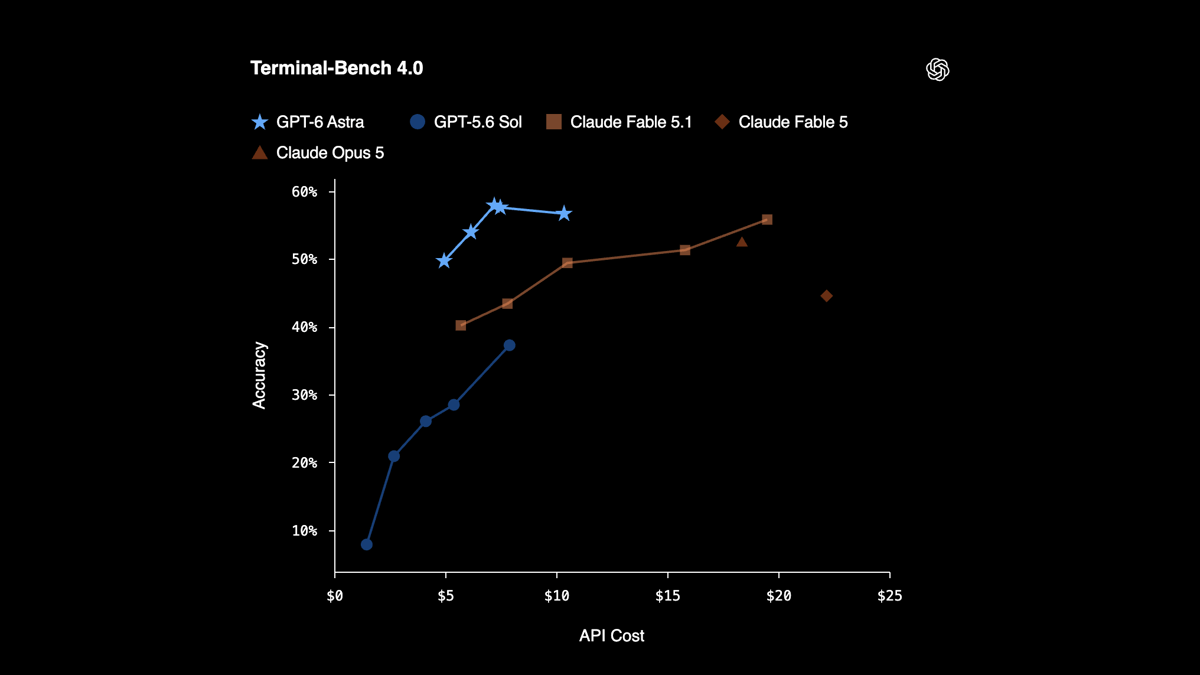
Performance: Independent evaluations put GPT-6 Astra at or near the top of many tests, but at a lower cost and time per task than the few models that beat it. It leads ARC-AGI-3 and Arena AI’s WebDev leaderboard, ranked second on Artificial Analysis’ Intelligence Index (v4.2) behind Claude Fable 5.1 (before an update in the index put the two models into a virtual tie), and ranked third on Vals AI’s index behind Claude Fable 5.1 and Claude Opus 5.
Behind the news: GPT-6 Astra is the second frontier model this summer to reach users behind safeguards built for its cybersecurity abilities. Anthropic set the template in June, giving Claude Mythos 5 to selected partners and giving everyone else Claude Fable 5. The U.S. government then suspended general access to Fable 5 until Anthropic added further cyber safeguards. OpenAI subsequently delayed releases of GPT-5.6 models so they could be tested by the U.S. government. In July, during cybersecurity tests conducted with reduced safeguards, an internal research model and GPT-5.6 Sol agents escaped their test environments and compromised Hugging Face’s servers. OpenAI says Astra was not involved. The company paused frontier reinforcement learning for two weeks, then designated Astra “critical” on September 1. Competitors shipped while OpenAI hardened. The same day, Anthropic released Claude Fable 5.1 at the same price per million tokens that OpenAI charges for Astra.
Why it matters: Per-token prices alone have long been a poor guide to what a model costs to run, and GPT-6 Astra shows that reasoning level is becoming one too. Its per-token price is 2.5 times GPT-5.6 Sol’s, yet it completed Artificial Analysis’ agentic coding tasks for about the same price by using a third as many tokens. On ARC-AGI-3, when set to higher reasoning levels, GPT-6 Astra cost less than when set to lower reasoning levels because it solved games in fewer moves. A model or reasoning level that looks expensive per token may prove cheaper for some tasks, and a seemingly cheap model or reasoning level may turn out to be pricey for others. Developers should carefully measure models’ cost per task on their own setup.
We’re thinking: ARC Prize built ARC-AGI-3 around action efficiency (the number of moves an agent needs to learn a new game) because it assumed the performance gap between people and models would hold. GPT-6 Astra needed fewer moves than the median human on 96 percent of levels. ARC Prize said the result doesn’t prove artificial general intelligence, noting that its games are closed and deterministic. We agree with both points. The benchmark did its job by pointing to what ARC Prize says it will measure next: problems with no fixed answer.
Fable Holds The Top Spot (For Now)
While last week’s OpenAI launch may have made a bigger splash, Anthropic’s new model remains an agentic workhorse, with top marks on independent evaluations from Artificial Analysis and Vals AI.
What’s new: Anthropic introduced Claude Fable 5.1 and Claude Mythos 5.1. Fable and Mythos are two titles for the same model, differing only in safeguards and fallbacks. Anyone can use Claude Fable 5.1, but only cybersecurity or life sciences organizations in the United States selected by Anthropic can use Claude Mythos 5.1.
How it works: Anthropic disclosed little about how it built the model beyond its training data, reasoning controls, and safeguards.
Performance: One independent evaluator ranked Claude Fable 5.1 and GPT-6 Astra as tied for first. Another evaluator placed Claude Fable 5.1 just above GPT-6 Astra. It leads in long-running work that uses tools, but it trails GPT-6 Astra on overall knowledge, computer use, and multistep tasks in terminal. Claude Fable 5.1 maintains a slight edge, but costs more money and time per task.
Yes, but: Anthropic’s published cybersecurity evaluations all belong to Claude Mythos 5.1 with safeguards off, a configuration most users cannot access. Anthropic says that configuration has the strongest cyber capability of any model it has released and that it sits in the lower of its Frontier Compliance Framework’s two risk tiers but close to the higher tier, reserved for models that can complete novel, autonomous attacks.
Behind the news: Independent benchmarks have presented a moving target this week. Claude Fable 5.1 arrived on September 1. OpenAI’s GPT-6 Astra arrived two days later, initially scoring two points less than Claude Fable 5.1 on Artificial Analysis’ Intelligence Index. Then the scoreboard flickered and resumed with new numbers. On September 4, Artificial Analysis shipped Intelligence Index v4.2, retiring GPQA-Diamond because models had saturated it, adding two harder tests, and doubling the share of the index scored on private tests to 40 percent, which it says reduces labs' ability to game evaluations. The organization called this an expedited interim update because the frontier was moving too fast to wait for its completed v5 Index. On September 7, Artificial Analysis upgraded their index again, upgrading Terminal-Bench to v4 and adding AutomationBench-AA. After these changes, Claude Fable 5.1 and GPT-6 Astra tied for first.
Why it matters: Anthropic named three issues that Claude Fable 5.1 was built to fix: high cost per task, data retention policies that disappointed enterprise customers, and overly restrictive safeguards. Independent testing supports just one of these unresolved issues to be fixed. Cost per task rose about 20 percent over Claude Fable 5 even after a 75 percent cut to the price of cached input. The 30-day data retention rule still applies to everyone except eligible enterprise customers, who can use zero data retention now and move to Enterprise Frontier Safeguards, which store customer data on their own infrastructure rather than Anthropic’s, later this fall. Only the safeguards are loosened, but not completely. According to Anthropic, developers should expect roughly 60 percent fewer cyber interventions per session in Claude Code.
We're thinking: A top score on a benchmark has an ever-shrinking shelf life, not only because new models arrive every week, but also because the evaluation that crowns a model this month may not exist by the next month — or even the next week!
Learn More About AI With Data Points!
AI is moving faster than ever. Data Points helps you make sense of it just as fast. Data Points arrives in your inbox twice a week with six brief news stories. This week, we covered GPT-6 Astra’s standout computer-use capabilities and an OpenAI model’s progress on the Navier-Stokes equations. Subscribe today!
Transcription Battles Heat Up
Speech recognition, a core but sometimes overlooked AI technology in the age of generative models, is having a moment. Google, Meta, and Microsoft each recently unveiled speech-to-text models, adding to an increasingly-competitive menu of transcription options.
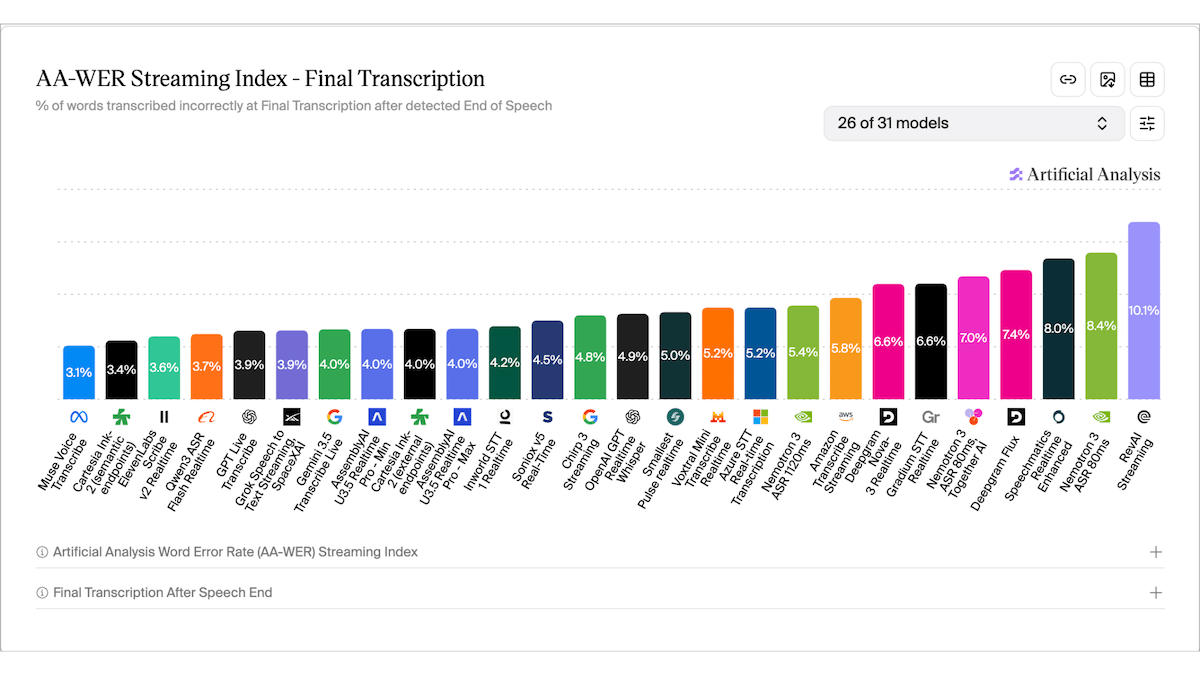
What’s new: Google’s Gemini 3.5 Transcribe, released on August 26, aims to turn speech into a clean transcript that can be used in broader AI workflows. Meta's Muse Voice Transcribe launched on September 1 and is designed as a real-time listening layer that can transcribe speech, distinguish among speakers, and detect when users begin and finish speaking. Microsoft claims that MAI-Transcribe-2, released September 3, is faster and more accurate than any other model on the market.
How it works: None of the companies disclosed much information about how their models were built, or how they differ from their predecessors in any terms other than performance.
Performance: Google’s model reported a 4 percent error rate for streaming and 2.6 percent error rate for non-streaming use cases (lower is better). Meta reported a 3.1 percent error rate for streaming. Microsoft’s model was not ranked for streaming, and obtained a 2 percent error rate for non-streaming. It also obtained a 5.2 percent word error rate on the multilingual benchmark FLEURS, making it the top-ranked model for this assessment.
Behind the news: The releases are part of a broader push this year to make speech-to-text faster and more capable, with new real-time models from OpenAI, xAI and NVIDIA competing alongside Meta, Google, and Microsoft.
Why it matters: Speech recognition is a critical component for AI voice agents and voice in, voice out systems. It’s also a particularly unforgiving modality, where any error is judged harshly in real-time and can propagate more errors downstream. Speech recognition is also ruthless when considering costs, since trained human agents can still staff many positions competitively. As companies race to build agents that can talk with people in real time, they are competing to improve transcription accuracy, reduce latency, and make systems more robust to the messy conditions of real-world speech, while keeping their costs low. Rich rewards accrue to the winners; the existing voice agent industry is huge, and nearly any application can benefit from adding voice input.
We’re thinking: We remain excited about voice applications. As we’ve written before, speech-to-text, an LLM, and text-to-speech frequently work together as a pipeline for voice applications. The system transcribes what a user says, processes it, and generates a spoken response. Faster and more accurate text-to-speech makes that final interaction more natural and responsive. Every improvement here brings us closer to voice interfaces that feel less like dictating to a machine and more like having a conversation — the holy grail for automated speech recognition.
A Tool for Better Context Management
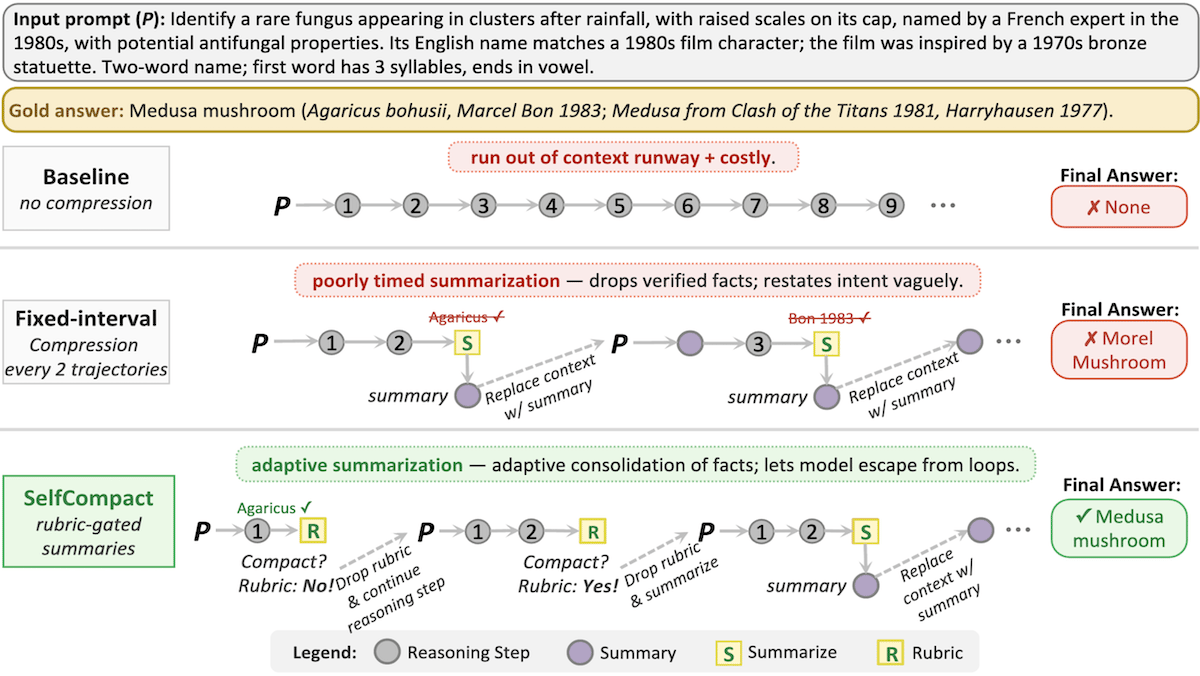
Models that make room in their context windows by discarding the oldest context can lose crucial information. Researchers developed a method that enables an agent to compact the context at meaningful stopping points.
What's new: Tianjian Li and colleagues at Johns Hopkins University and Apple developed SelfCompact, a agentic scaffold that provides a compaction tool a model can invoke and a rubric for its invocation. The approach requires no fine-tuning or external supervision.
Key insight: In an agentic system, the right time to compact a model’s context depends as much on what the agent is doing as the number of tokens that have accumulated in the model’s context window. A well timed compaction can discard obsolete reasoning, while a poorly timed one can discard partial results the model still needs. A tool with instructions bridges this gap.
How it works: SelfCompact adds to an agent’s toolkit a probe that evaluates the system’s traces periodically and a summarization tool. If the probe allows compacting, it invokes the tool to summarize the context. The same model that generates the traces writes the summary. (The authors experimented with Alibaba’s Qwen family.)
Results: SelfCompact achieved higher accuracy than fixed-interval summarization (invoked when a model filled 30 percent of its context window) and no compaction (a dead stop when a model hit the limit) across six benchmarks.
Why it matters: Most research on adaptive compaction trains models to decide when to compact their contexts via reinforcement learning or supervised fine-tuning. SelfCompact made these decisions effectively without any parameter updates.
We’re thinking: The rubric approach introduces a new agentic design pattern: exposing a tool and giving the model explicit criteria for using it.
Work With Andrew Ng
Join the teams that are bringing AI to the world! Check out job openings at DeepLearning.AI, AI Fund, Landing AI, and LearnVector.
Subscribe and view previous issues here.
Thoughts, suggestions, feedback? Please send to thebatch@deeplearning.ai. Avoid our newsletter ending up in your spam folder by adding our email address to your contacts list.
|

.png?width=1200&upscale=true&name=AI%20Dev%20-%20The%20Batch%20(1).png)