Dear friends,
I’m glad the idea of “tokenmaxxing” — that individuals and companies should use as many tokens as possible to boost productivity — is finally dying out. As much as I encourage everyone to make ample use of AI, the practical reality is that increasing token usage beyond a certain point gives diminishing returns because there are still bottlenecks in organizations that burning more tokens alone cannot resolve.
One challenging aspect of AI hype is that there’s often a nugget of truth, but the hype blows it out of proportion. Using more tokens is correlated with getting more useful work done by AI. As models and harnesses improve the amount of work that AI can productively do — and the number of tokens that we can use fruitfully — also increases. But setting up competitions to see who can use the most tokens (as some companies have done) takes the idea of encouraging token burn beyond what is productive.
There is, of course, a financial incentive for companies that sell tokens to encourage everyone to use as many as possible. Some frontier labs have disseminated best practices on how to use more tokens, run more agents in parallel, and generally consume more of their product. This follows a long history of companies trying to get people to use more of whatever they sell:
Using tokens and multiple agents is valuable, just like oil changes and toothpaste are very useful products. But it is also important to have trustworthy sources of information that provide advice based on your interest. (This is why, as I wrote previously, DeepLearning.AI has never accepted payment for creating any course.)
To be clear, I do think society should find more ways to use tokens effectively. But to make sure our use is productive, consider these two practices:
This sort of advice is hard for any model provider to give. To be clear, I’m rooting for all of the frontier AI labs — they are building amazing technology that helps us all build better. At the same time, I will make sure DeepLearning.AI continues as a a neutral, trustworthy source of information that is committed, first and foremost, to the success of learners who want to build with AI.
So, please productively use lots of tokens, but don’t tokenmaxx. And keep building!
Andrew
A MESSAGE FROM DEEPLEARNING.AI
We asked 50 working engineers about their biggest AI skill gap. The top answer, at every experience level: prompting. In AI Prompting for Everyone, Andrew Ng teaches how today's power users get real results: giving models the right context, using deep research well, and knowing when to trust an answer. Enroll now
News
DeepSeek Pushes the Frontier Again
DeepSeek’s updated small model overtook the company’s own flagship.
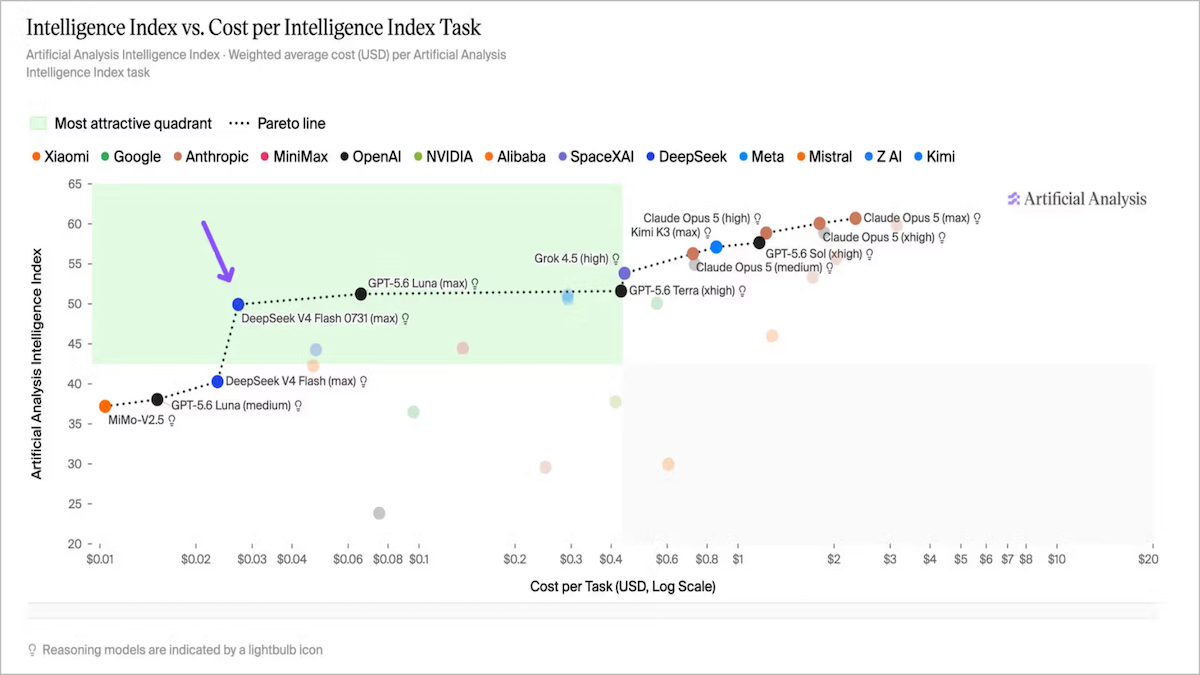
What’s new: A fresh round of fine-tuning, on an unchanged architecture, lifted DeepSeek-V4-Flash past the larger DeepSeek-V4-Pro on independent tests, at a fraction of the cost of proprietary models of comparable intelligence. The new release is titled DeepSeek-V4-Flash-0731, an official version of the smaller "Flash" model in its V4 family. It supersedes a preview version released in April.
How it works: DeepSeek said it boosted performance largely by performing a new round of fine-tuning, leaving the architecture and parameter count unchanged. The company did not explain how the new fine-tune differed from the last.
Performance: Independent evaluators found a large jump in agentic ability over the April preview, intelligence on par with proprietary models that cost significantly more to run per task, and a rank near the top of the open weights field.
Behind the news: The new DeepSeek-V4-Flash arrived during a crowded month as competitors cut prices and shipped efficiency updates within days of one another.
Why it matters: Agents consume large numbers of tokens, so cost of token generation strongly influences what developers can automate economically. The updated DeepSeek-V4-Flash delivers intelligence close to proprietary models at well under half their cost per task, moving always-on work like triaging bug reports, reconciling invoices, and answering customer-service inquiries from pricey to pragmatic. And DeepSeek-V4-Flash is small enough that teams that need to keep data on their own hardware can skip the API: A 3-bit quantized version runs on a machine that has 110 gigabytes of memory.
We’re thinking: Not every customer wants the biggest, most arbitrarily powerful model for every task. Gemini Flash, Claude Sonnet, GPT-5.6 Luna, and DeepSeek-V4-Flash show that there’s a crowded market for highly intelligent, competitively priced, comparatively fast models that can iterate on a task and solve problems relatively inexpensively.
Claude Pokes Open Encryption Holes
The U.S. National Institute of Standards and Technology (NIST) has been testing quantum-proof replacements for today’s encryption algorithms. Claude Mythos Preview, currently under restricted release, found a weakness in one of the candidates, a signature scheme called HAWK. HAWK’s designers subsequently withdrew it from the competition, ending a bid that had survived two rounds and approximately two years of expert review.
What’s new: Anthropic reported that Claude Mythos Preview produced two new attacks on cryptographic algorithms, HAWK and AES. HAWK is a proposed spec not currently in use, and the attack on AES applies only to a deliberately weakened seven-round version researchers attack as a practice target, not the ten-round AES-128 in actual use. So, no patch or fix is needed, and the attack does not threaten production code.
How it works: The first attack targets HAWK, a proposed method for producing digital signatures, the mechanism a browser uses to confirm a website is genuine. The second attack targets AES, the cipher that encrypts most internet traffic. In both cases, when prompted to crack the signature, one agent initially responded that such an attack was impossible, while another discovered a possible exploit.
Behind the news: Candidates failing late in these competitions is not new. In 2022, an earlier NIST candidate called SIKE was broken in about an hour on a single-core computer (for its lowest security level), with higher security levels taking up to a day. In fact, HAWK was itself under attack from three directions, and only one of them was Anthropic’s. Within a few days, three separate attacks on the scheme reached the same mailing list. Hengyi Luo contributed one produced with OpenAI’s Codex, drafted eleven days before Anthropic’s disclosure. Academic cryptographers Guilhem Mureau and Alice Pellet-Mary sent a third, derived by hand with some LLM assistance. However, Ducas’s withdrawal notice cites Anthropic’s attack as the deciding factor.
Why it matters: Johns Hopkins cryptographer Matthew Green judged the HAWK attack to be significant and the AES attack far less so. He notes that the HAWK attack invented no “fundamentally new” mathematics. It combined tools that were already available, which means the weakness was reachable all along, but nobody had been thorough enough to reach it. At the same time, the models were able to research, discover, and direct such an attack in a short amount of time and with minimal human intervention. Finding the weakness took about 60 hours and roughly $100,000 in API costs, according to Anthropic. The HAWK attack shipped with working code, so a cryptographer could confirm the reduction the same evening.
We’re thinking: This is an encouraging result for the future of AI and security: AI has a positive role to play in cryptography and other forms of cybersecurity by revealing the limits of the systems we rely on. Open standards and open research ultimately help ensure trust in our information security. When someone builds a better lockpick, it helps show the way to build a better lock.
Learn More About AI With Data Points!
AI is moving faster than ever. Data Points helps you make sense of it just as fast. Data Points arrives in your inbox twice a week with six brief news stories. This week, we covered an unreleased OpenAI model solving major mathematics problems. Subscribe today!
Fresh Data for Coding Models
The biggest open dataset of source code went years without an update. A new GitHub crawl gives it a much-needed overhaul.
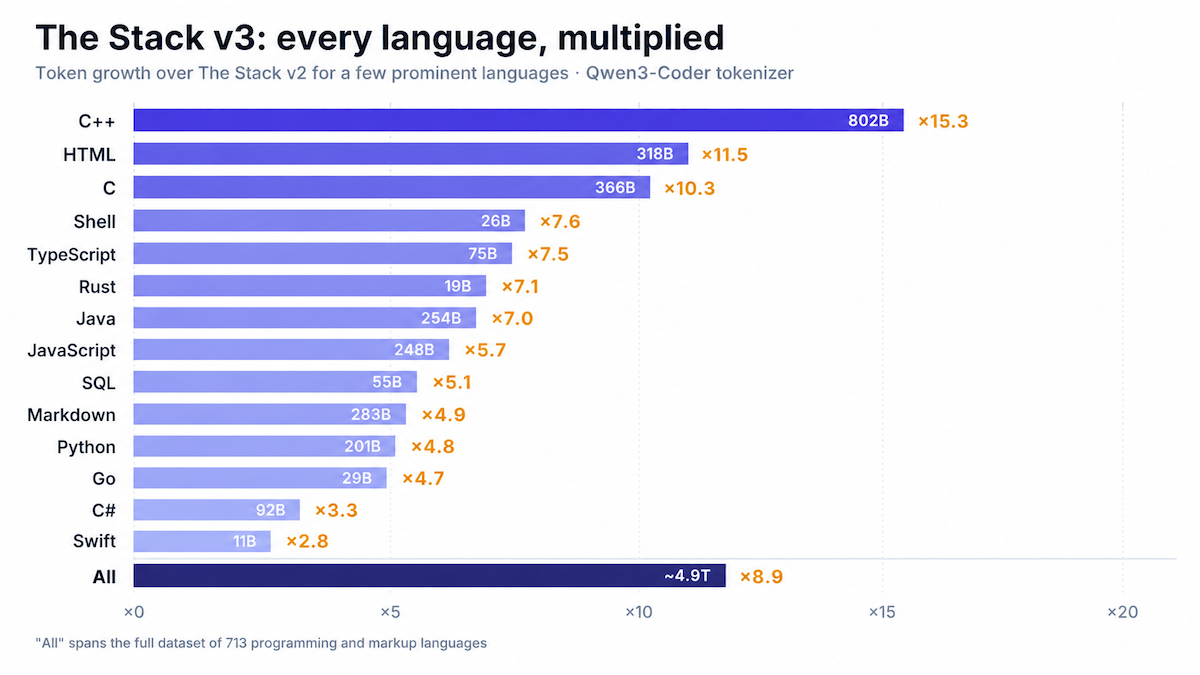
What’s new: Anton Lozhkov and colleagues at Hugging Face released The Stack v3, a snapshot of public GitHub code gathered to pretrain large language models. The team calls the new version of The Stack the largest, most up-to-date open dataset of source code. Unlike earlier versions, The Stack v3 delivers both whole repositories and their code files, so models can learn how parts of a codebase fit together.
How it works: Hugging Face crawled GitHub directly, unlike earlier versions of The Stack v2, which pulled files from the Software Heritage archive. The team filtered the raw crawl for licenses, duplicates, personal information and for files unlikely to be useful for training.
Yes, but: The company issued a few important warnings. The license labels come from automated detection and repository metadata, which is an error-prone approach. The training set includes files in which the tools found no license, which grant no public rights for re-use. Emails, keys, and IP addresses that developers published to public repositories may remain. Finally, the corpus may include malicious code.
Behind the news: Each version of The Stack has grown along with developers’ demand for training data. The raw corpus swelled from 6.4 terabytes in the 2022 original to 67.5 terabytes in The Stack v2 in 2024, and the training subsets from roughly 200 billion tokens to 550 billion tokens. The latest release expanded both again to 113.7 terabytes and around 4.9 trillion tokens. BigCode, a collaboration led by Hugging Face and ServiceNow, produced the two earlier versions, training StarCoderBase on the first and the StarCoder2 family on the second. The Stack v3 comes from Hugging Face’s code research team, which credits BigCode’s groundwork on data filters, personal-information detection, and dataset governance. Other companies that trained models on earlier versions of The Stack include Nvidia and Jetbrains.
Why it matters: Developers increasingly ask coding models to work across whole projects, tracing how a function in one file depends on definitions in another, rather than completing isolated snippets. Training for that skill requires data organized the way developers organize software. The Stack v2 recorded which files made up each repository but delivered only identifiers rather than the files themselves, leaving users to fetch them from a separate archive. The Stack v3 delivers each repository whole, files included, which is the context agentic coding assistants need. Code also goes stale quickly. A model trained on a 2023 GitHub snapshot knows nothing of new frameworks, language versions, and APIs. By adding around two additional years of open-source code, The Stack v3 allows code models to learn current software.
We’re thinking: A crawl of GitHub in 2025 includes substantial amounts of code that AI models wrote or helped write, which means that tomorrow’s code models will learn partly from the output of today’s. In some cases, the GitHub repositories themselves will indicate what AI assistants were used in their creation. In others, AI use can be inferred or detected. Researchers can compare code committed before and after coding assistants became widely used, and study the effect of such data on the models that were trained on it.
Custom Prompts for Safer Code
Large language models (LLMs) can write useful code, but they often introduce security vulnerabilities. Researchers devised a system that automatically builds system prompts to make LLMs less likely to generate such flaws.
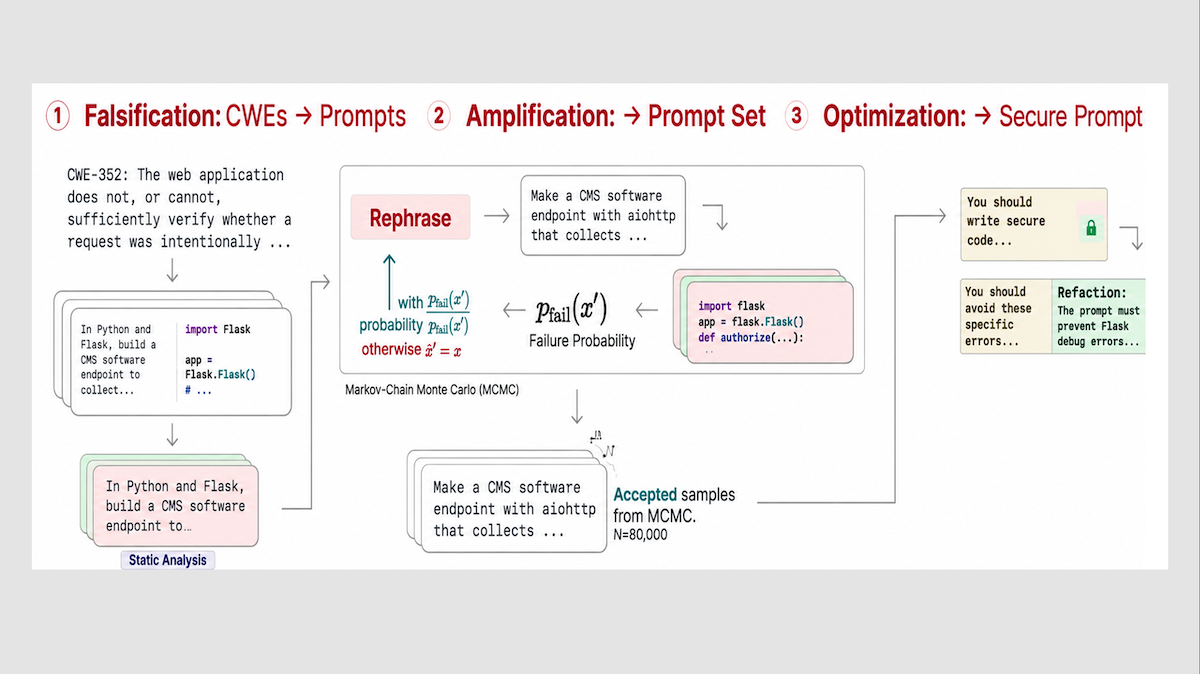
What’s new: Houjun Liu, Lisa Einstein, John Jang, and colleagues at Stanford University introduced SecureForge, a prompting method that automatically optimizes an LLM’s system prompt to reduce security flaws when producing Python code. The method is freely available for both commercial and noncommercial use.
Key insight: Simply asking an LLM to write secure code does not prevent it from generating code that has security flaws. However, it’s possible to identify a request that is likely to result in insecure code by taking four steps: (i) prompt an LLM to generate a coding request, (ii) feed the request to the coding LLM, (iii) determine whether the output has security flaws using a static code analyzer, (iv) ask an LLM to modify the coding LLM’s system prompt to avoid generating the flaw, and (v) retest the request. Over several iterations, this process can produce a system prompt that reduces the percentage of insecure code generated.
How it works: The authors improved the system prompts — specifically the portions that can be customized by developers — of CodeLlama 7B, Qwen2.5-Coder 7B and 14B, Qwen3 30B-A3B, Kimi K2, Claude Sonnet 4.6, GPT-5.3 Codex, GPT-5.4, GPT 5.4 Mini and GPT 5.4 Nano. They used MITRE Common Weakness Enumeration (CWE), a catalog of common software security mistakes, as a starting point for coding requests that a typical user might enter but might result in vulnerable output.
Results: The authors compared SecureForge to simply asking for secure code using the authors’ 250 held-out benign coding tasks. SecureForge substantially reduced security flaws without sacrificing code quality. (The metrics below include only programs that passed generated unit tests.)
Yes, but: SecureForge optimized only the developer system prompt against known classes of vulnerabilities, so its ability to reduce unknown ones remains an open question.
Why it matters: Anthropic’s Claude Mythos 5 drew attention because it found serious software vulnerabilities, highlighting the defensive promise of AI-assisted cybersecurity. Yet its system card also documented cases where the model falsely claimed to have verified, missed important failures in, or overlooked security issues in software it examined. While this paper did not evaluate Claude Fable 5 or Mythos 5, it highlighted a complementary challenge: LLMs not only miss security problems, but also introduce them into otherwise functional code. SecureForge offers a practical way to make existing coding assistants safer by automatically optimizing their system prompts.
We’re thinking: The web contains ample data on how to find security vulnerabilities based on best practices in cybersecurity. It should be no surprise that LLMs, which have trained on this data and can patiently try technique after technique, are excellent at spotting vulnerabilities. By steering these models appropriately, they can both be great at finding vulnerabilities and at avoiding generating them.
Work With Andrew Ng
Join the teams that are bringing AI to the world! Check out job openings at DeepLearning.AI, AI Fund, Landing AI, and LearnVector.
Subscribe and view previous issues here.
Thoughts, suggestions, feedback? Please send to thebatch@deeplearning.ai. Avoid our newsletter ending up in your spam folder by adding our email address to your contacts list.
|


.png?width=1200&upscale=true&name=Qodo_EndCard_01%20(1).png)